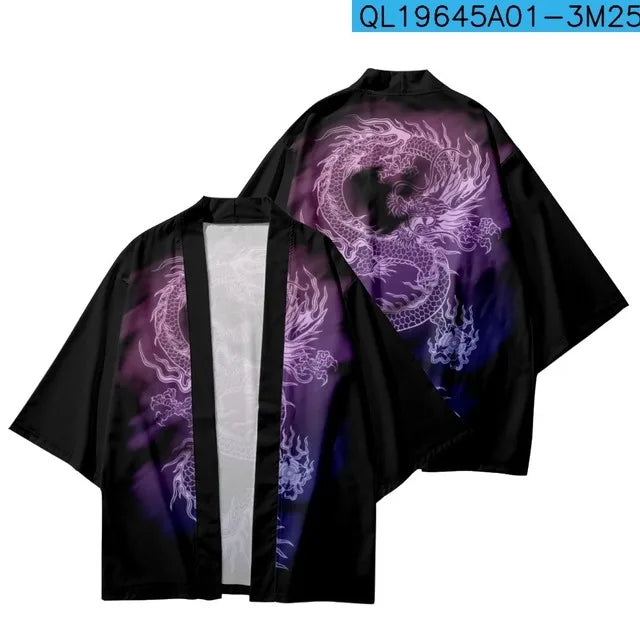
What Is a Haori? Haori vs Kimono vs Kimono Jacket Explained
A haori is a traditional Japanese jacket worn over a kimono. It is shorter than a kimono, usually reaching somewhere between the hips and the knees, it hangs open at the front instead of wrapping closed, and it is held together loosely by a pair of cords called haori-himo. Think of it as the Japanese equivalent of a light coat or cardigan: a layer you add on top, not the main garment. Today the haori has also become a favorite in streetwear, worn over a T-shirt and jeans just as easily as over a kimono.
If you have been browsing haori jackets and wondering how they differ from a full kimono or from what shops call a kimono jacket, this guide breaks it down: where the haori comes from, how to recognize one, and how to wear it now.
What Is a Haori? The Short Definition
The haori is an outer layer from traditional Japanese dress. Its key features are easy to spot once you know them:
- Open front: the two front panels do not overlap. A kimono wraps left over right and is closed with an obi belt; a haori simply falls open.
- Folded-back collar: the collar band runs down both front edges and is usually folded back, which gives the haori its clean, lapel-like line.
- Cord closure: instead of buttons or a belt, small cords (haori-himo) tie at chest level. Many people leave them untied or skip them entirely.
- Shorter length: a haori is cut shorter than the kimono underneath it, so the garment below remains visible.
- Kimono-style sleeves: wide, rectangular sleeves built on the same straight-seam construction as a kimono.
Because it is worn on top, the haori was never meant to be tucked, belted or layered under anything. That is exactly why it translates so well to modern outfits.
A Brief History of the Haori
The haori grew out of the need for a practical outer layer. During Japan’s era of warring states, samurai wore a sleeveless or short-sleeved coat called a jinbaori over their armor for warmth and visibility on the battlefield. Over time, a lighter version worn over everyday clothing took hold among men of the warrior class.
In the Edo period (1603 to 1868), the haori spread beyond samurai to merchants and townspeople. It became a sign of being properly dressed: going out in a kimono without a haori could look too casual for formal occasions. Formal men’s haori in black silk were marked with family crests (kamon), and the combination of crested haori, kimono and hakama trousers became the standard for ceremonies such as weddings. That outfit is still recognized as men’s formal dress in Japan.
The haori was originally a men’s garment. Women began wearing it in the Edo period, with the geisha of the Fukagawa district in Edo often credited as early adopters, and by the late nineteenth and early twentieth centuries it had become a common layer for women as well. For a deeper look at the garment’s background, the Wikipedia entry on the haori is a good starting point.
The hidden lining tradition
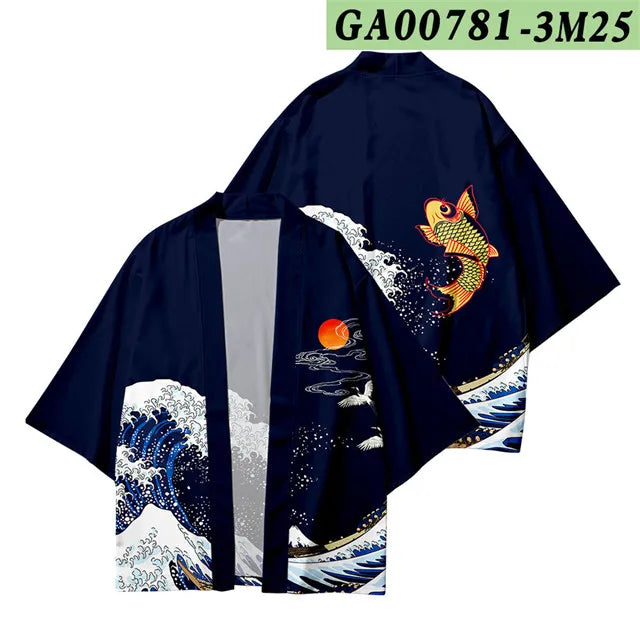
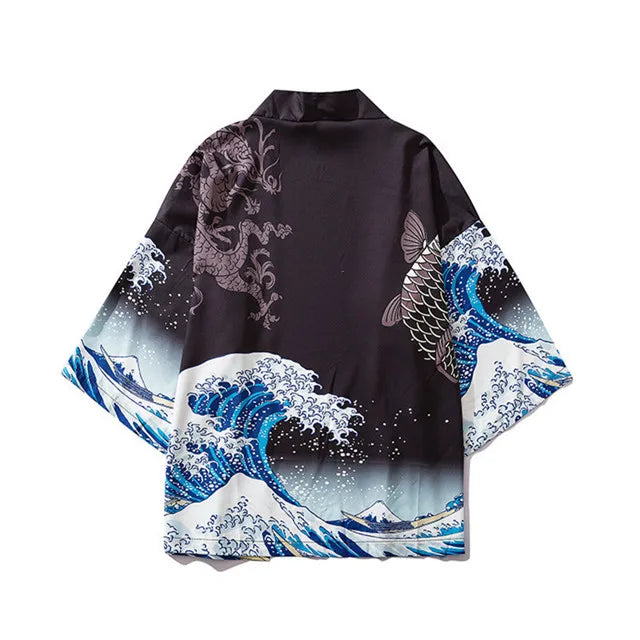
One of the most charming details of the haori is its lining, called haura. Men’s haori were often plain or dark on the outside while the lining carried bold, elaborate artwork: landscapes, dragons, legends or poetic scenes. This understated-outside, expressive-inside approach is often linked to the Edo-era rules that limited displays of luxury. Today the idea lives on in a different form: many modern haori bring the dramatic artwork to the outside, with dragons, cranes, moons and forests printed across the whole jacket.
Haori vs Kimono vs Kimono Jacket
These three terms get mixed up constantly, especially online. Here is how they compare:
| Feature | Kimono | Haori | Kimono jacket (modern) |
|---|---|---|---|
| Role | Main garment | Outer layer worn over a kimono | Outer layer worn over everyday clothes |
| Length | Ankle length | Hip to knee length | Usually hip to mid-thigh |
| Front | Wrapped closed, left over right | Open, panels do not overlap | Open, sometimes with a tie or belt |
| Closure | Obi belt | Haori-himo cords | Varies: none, tie, or sash |
| Typical use today | Ceremonies, festivals, special events | Traditional dress and streetwear | Casual and fashion layering |
Haori vs kimono
A Japanese kimono is the full-length garment that wraps around the body and is secured with an obi. A haori is the jacket that goes over it. You can wear a kimono without a haori, but a traditional haori was designed to sit on top of a kimono. In short: the kimono is the outfit, the haori is the coat.
Haori vs kimono jacket
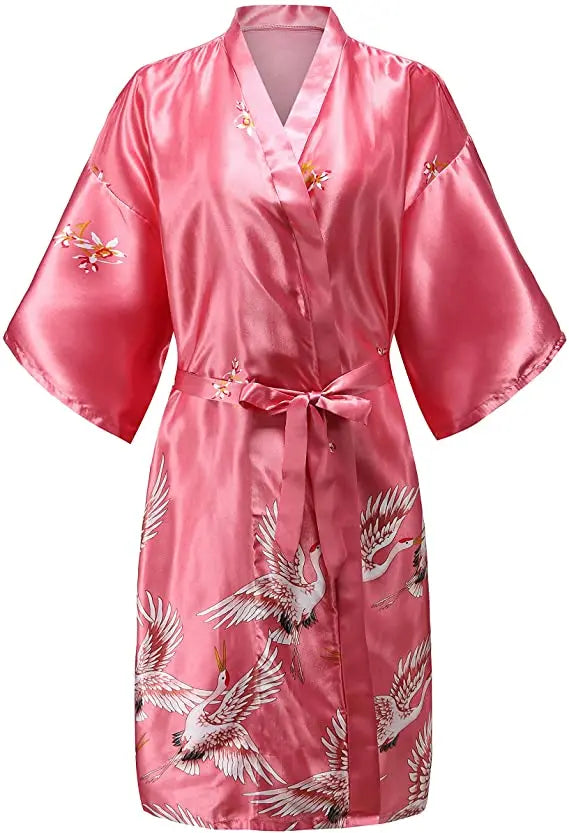
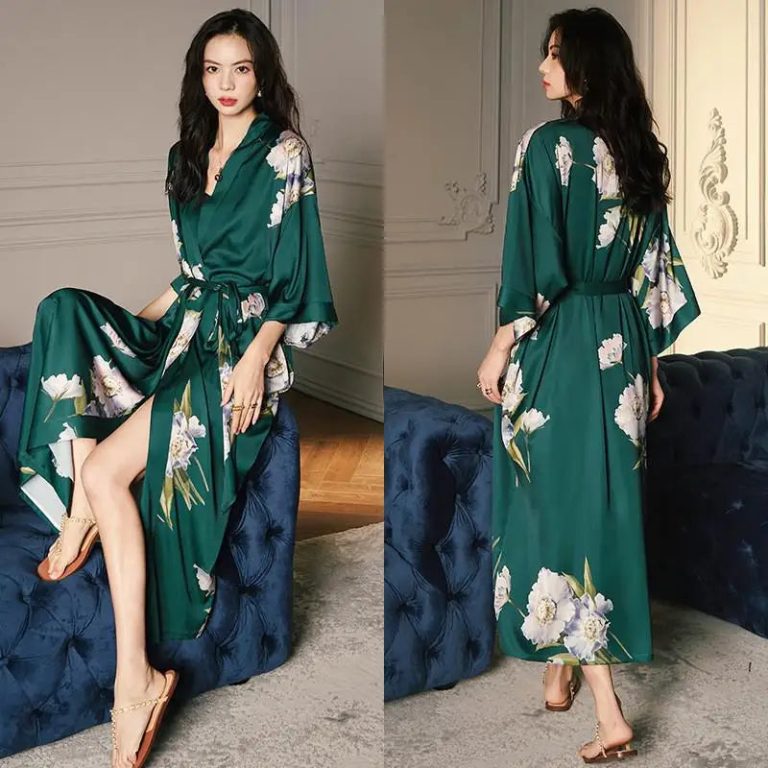
“Kimono jacket” is a broader, more modern term. It describes any short, open-front jacket that borrows kimono elements, especially the wide straight sleeves and the long collar band. A haori is the specific traditional garment; many kimono jackets are inspired by it and look very similar, but they are often cut and styled for western wardrobes. In practice, the terms overlap a lot, and plenty of people use “haori jacket” and “kimono jacket” interchangeably when shopping.
Haori vs haori cardigan
“Haori cardigan” is mostly a fashion label rather than a traditional category. It points to the way the haori is worn: open, relaxed and layered like a cardigan. If you are looking for a lightweight layer to throw over a top, a haori cardigan and a haori jacket fill the same role.
Men’s Haori vs Women’s Haori
Traditionally, men’s and women’s haori differed in a few ways:
- Colors and patterns: formal men’s haori leaned toward black, navy, grey and other muted tones, with decoration saved for the lining. Women’s haori embraced brighter colors and visible patterns such as florals.
- Sleeves: women’s kimono and haori sleeves are generally longer and more rounded at the edge, while men’s sleeves are shorter and more squared.
- Length: women’s haori came in a wider range of lengths depending on fashion trends of the time, from short to nearly knee length.
Modern haori jackets are much less strict. Many are designed as unisex pieces with a relaxed fit, so the choice is more about the print and the length you like than about gender. If you want a more classic masculine look, browse the men’s kimono selection, where darker tones and bold motifs like dragons are common.
How to Wear a Haori Today
The haori is one of the easiest pieces of Japanese clothing to integrate into a modern wardrobe. Because it is open and unstructured, it works as a statement layer without much effort.
Streetwear
Wear a haori over a plain white or black T-shirt with straight or wide-leg pants and clean sneakers. Let the jacket be the focal point: if the haori has a large print, keep everything else simple and solid-colored. A dark haori with a bold dragon, such as this black haori jacket with a purple gradient dragon, does the work of an entire outfit on its own.
Anime-inspired and cosplay looks
Haori are instantly recognizable to anime fans, thanks to series where characters wear patterned haori over their uniforms. You do not need a full costume to reference that style: a haori over a dark top and pants already creates the silhouette. Celestial and nature prints work especially well for this kind of look, like the moon forest haori jacket with its purple night-sky palette.
Smart casual
A haori in a muted color can replace a blazer or overshirt. Pair it with a fitted knit, chinos and leather shoes or boots. Shorter, darker haori look sharper; longer ones feel more relaxed.
Over a kimono or yukata
For festivals, cultural events or traditional photo shoots, wear the haori the original way: over a kimono or yukata, with the haori-himo tied loosely at the chest. The haori should be shorter than the garment underneath so the layers stay visible.
Styling tips that always work
- Balance the print: one patterned piece per outfit is usually enough.
- Mind the length: hip-length haori suit slimmer pants; longer haori pair well with wide-leg trousers or a dress.
- Leave it open: the haori is designed to hang open, so avoid belting it tightly.
- Roll or push the sleeves if they feel too wide for daily tasks.
- Layer for the season: over a T-shirt in warm weather, over a hoodie or knit when it gets cooler.
How to Choose Your First Haori
Start with how you plan to wear it. For everyday streetwear, a unisex haori in black or navy with one strong motif is the most versatile choice. For a statement piece, look at all-over prints: dragons, cranes, moons, waves and forests are classic Japanese motifs that read clearly from a distance. Check the length in the product details and compare it to a jacket you already own, so you know where it will fall on your body.
Most importantly, pick a design you will actually want to wear often. A haori is a layer you reach for again and again, so the print should feel like you.
FAQ
What is a haori used for?
Traditionally, a haori is worn over a kimono as an outer layer, much like a light coat, and crested black haori are part of formal men’s dress in Japan. Today it is also worn as a fashion jacket over everyday clothes.
Is a haori the same as a kimono?
No. A kimono is a full-length garment that wraps closed and is secured with an obi belt. A haori is shorter, open at the front, and is worn on top of a kimono or other clothing.
Can anyone wear a haori?
Yes. The haori is worn by people of all backgrounds, in Japan and around the world. Wearing it respectfully simply means appreciating its origins and styling it with care.
Do you tie a haori closed?
Traditional haori have cords called haori-himo that tie loosely at chest level. In casual and streetwear styling, most people wear the haori fully open.
Is a haori for men or women?
Both. The haori started as a men’s garment and was later adopted by women. Many modern haori jackets are cut as unisex pieces with a relaxed fit.